By Shanti Kaur
Handling the Guru’s money is a sacred trust. When money is used properly, it serves and secures the sangat; when it is used for personal gain, it becomes an obstacle upon the very path it was meant to protect. Near the end of the 17th century, Guru Gobind Singh confronted such a crisis within the Sikh community with the masands. His abolition of the masand system was not simply an administrative reform. It was a decisive act intended to restore integrity, remove untrustworthy intermediaries, and prepare the Sikh Panth for the creation of the Khalsa.
Guru Gobind Singh became the 10th Sikh Guru in 1675, following the martyrdom of his father, Guru Tegh Bahadur, in Delhi. He was only nine years old! In the years that followed, he transformed Anandpur Sahib into a flourishing spiritual and martial center. Seekers from all walks of life gathered in the Guru's presence. Sacred compositions were recited and discussed, languages and literature were studied, and young Sikhs were trained in horsemanship and the use of arms.
This combination of spiritual devotion and martial discipline reflected the demands of the time. The Mughal Empire under Aurangzeb had become increasingly intolerant, while the hill rulers surrounding Anandpur were uneasy about the Guru's growing influence. Guru Gobind Singh was therefore preparing the Sikhs to defend themselves and others, cultivating Bir Ras, courage without cruelty.
Yet before the community could meet the dangers gathering outside Anandpur Sahib, the Guru had to address the corruption within it.
The masand system had not begun as a corrupt institution. Its roots lay in the manji system established by Guru Amar Das, who appointed trusted Sikhs to guide distant sangats. As the Sikh community expanded over South Asia, it became impossible for every Sikh to visit the Guru regularly. Local representatives were needed to organize and collect the offerings of the sangat, bring it periodically to the Guru's treasury.
Under Guru Arjan Dev, this network became more formally organized. The representatives came to be known as masands, a word derived from the Persian masand, meaning a seat or cushion of authority. Chosen for their devotion and integrity, they preached the teachings of the Gurus and collected dasvandh - the voluntary contribution of one-tenth of one's earnings. These resources supported the langar, provided aid to the poor, and funded the growing institutions of the Sikh Panth. In its original form, the masand system united widely scattered sangats and enabled them to participate in a shared spiritual life of community and in sincere devotion to the Guru.
Over time, however, the system's strengths became its vulnerabilities. Because masands lived at a distance from the Guru and controlled the flow of information and significant money, some acquired considerable local power. Positions of responsibility even became hereditary in certain places. Some masands retained for themselves offerings intended for the Guru, demanded money from the sangat and used their authority to build personal followings. A few began to act as if they themselves were spiritual masters rather than servants of the Guru.
It is important not to condemn every masand indiscriminately. Sikh historical accounts preserve the names of masands who remained faithful, and some former masands continued to serve Guru Gobind Singh after the office was abolished. The corruption was nevertheless serious enough that the institution itself could no longer be trusted. What had been created to connect the Sikh to the Guru had, in many places, become a barrier between them.
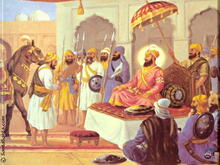
Complaints eventually reached Anandpur. According to Sikh history, theater performances presented for the sangat and before Guru Gobind Singh dramatized the arrogance and misconduct of certain masands. Their behavior was depicted so vividly that members of the sangat came forward with further testimony. The Guru ordered the masands to appear at Anandpur and answer the charges against them.
The masands were summoned and tried in March 1698. The proceedings reportedly took place within the Guru ke Mahal complex, the home of his youth and that of his parents. Charges were heard against the masands, one by one, and conduct was examined. The account of Bhai Rau, the masand of Dipalpur, is particularly significant: he was declared innocent after the respected Bhai Pheru testified to his integrity. Takht Mall, a masand of the Nakka region, confessed his wrongdoing and received the Guru's pardon because his remorse was sincere. The Guru and the voice of the sangat distinguish innocence and repentance from theft and corruption.
Those found guilty received severe punishment. Inside the Guru ke Mahal complex is an old well traditionally known as Masandan da Khooh, the Well of the Masands. Local Sikh tradition holds that some of the masands found guilty were condemned and thrown into this well. The association of the well with this judgment remains an important part of the history of Guru ke Mahal, and the enduring memory of the sangat.
A greater judgment was directed against the institution itself. Guru Gobind Singh abolished the office of masand and instructed the Sikhs not to recognize the masands, their families, or their deputies as representatives of the Guru. Offerings were henceforth to be brought or sent directly to the Guru. The sangat would no longer require an intermediary to approach him, and his court was open to all.
This change anticipated the creation of the Khalsa at Baisakhi in 1699. The abolition of the masands removed a hierarchical structure based upon delegated privilege. The Khalsa established a community founded upon direct commitment, shared discipline, and spiritual equality. Authority would no longer rest in a local official because he occupied a seat or controlled the offerings of the sangat. It would rest in fidelity to the Guru's teachings and in accountable service to the Panth.
The lesson extends far beyond the 17th century. Institutions are necessary, but no institution is sacred merely because its origins were sacred. Every structure must continue to serve the purpose for which it was created. Whenever religious authority becomes a source of wealth, fear, or personal domination, it has betrayed its trust.
Guru Gobind Singh did more than remove corrupt officials. He gave the Sikhs direct responsibility for their spiritual life. The future of the Panth would depend upon awakened human beings who embodied the Guru's wisdom in their own lives. In the Khalsa, a Sikh stands before the Guru without a gatekeeper - disciplined, trustworthy, sovereign, and prepared to serve.
Sources and Historical Note
- The broad history of the masand institution, its corruption, its abolition, and the Anandpur proceedings is well supported. The precise manner and number of executions at the historic well vary in later accounts:
- Harbans Singh, ed. The Encyclopaedia of Sikhism. Patiala: Punjabi University, 1992-1998. Entries: 'Masands,' 'Rau, Bhai,' 'Takht Mall,' and 'Damdama Sahib Gurdwara, Anandpur.' Online reference
- J. S. Grewal. Guru Gobind Singh (1666-1708): Master of the White Hawk. New Delhi: Oxford University Press, 2019. Online reference
- Purnima Dhavan. When Sparrows Became Hawks: The Making of the Sikh Warrior Tradition, 1699-1799. New York: Oxford University Press, 2011. Online reference
- Sarup Singh Kaushish. Guru Kian Sakhian: Tales of the Sikh Gurus, trans. Kulwant Singh. A traditional narrative source for the Anandpur proceedings. Online reference