By Shanti Kaur
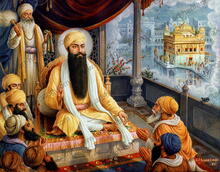
Guru Ram Das (1534–1581) is the fourth Guru of the Sikhs and the founder of the nectar tank and holy city of Amritsar. The beautiful Siri Harmandir Sahib, also known as the Golden Temple, stands today as a testament to the love of Guru Ram Das.
Guru Ram Das was born in Lahore in 1534 to Haridas and Devi Anup Devi. They named him Jetha, meaning the firstborn. His mother died while he was still very young, and his father struggled to care for him while earning a living. Knowing that his own health was failing, Hari Das taught the boy to support himself by selling cooked wheatberries in the marketplace. Before long, his father also died, leaving him alone in the world at the tender age of seven.
His grandmother brought him home to Basarke, the ancestral village of Guru Amar Das. Ji. His grandmother was devoted to Guru Amar Das, so when he established the town of Goindwal, Jetha and his grandmother moved there as well.
In Goindwal, Jetha continued to earn an honest living, but he now placed himself wholeheartedly in the Guru's service. He worked in the langar, carried water and firewood, welcomed visitors, and joined the labor of excavating the great baoli, or stepped well, at Goindwal. No task was too ordinary for him. The hands that had once carried a basket through the streets of Basarke now carried provisions for the Guru's kitchen and earth from the community well.
Guru Amar Das recognized the light of spiritual greatness within this humble young man. He took Jetha as his devoted disciple, guiding and mentoring him with deep love. Guru Amar Das gave him his own daughter, Bibi Bani, in marriage, a gesture of both trust and spiritual union. Ram Das’s humility, devotion, and spiritual depth were immense.
When the time came, Guru Amar Das appointed him as his successor and installed him as Guru Ram Das, the fourth Guru of the Sikhs.
In 1574, at Guru Amar Das's direction, Guru Ram Das began the huge task of excavating the Amrit Sarovar, the sacred Pool of Nectar. Here, he laid the foundation stone for the new city of Ramdaspur that would later become known as Amritsar. Guru Arjan Dev Ji, the son and successor of Guru Ram Das, built the Harmandir Sahib, the Golden Temple, in his father’s honor.
Gobind Singh Mansukhani writes in his book Guru Ram Das,
“Here was an unschooled boy who manifested his scholarship and spiritual wisdom in the court of Emperor Akbar and who held his ground in the discussions and debates with Pundits, Yogis, and mystics. Here was a helpless and homeless child who in due course established a new city for the Sikh community [the holy city of Amritsar]… The miracle [of Guru Ram Das, the “Karamat”] reveals that this young man, who never went to a music teacher or school, became a versatile singer of Sikh sacred music and composed hymns in thirty raags. All these extraordinary events go to prove that destiny had earmarked this humble servant of the Sangat for the greatest achievement in human life – the throne of spirituality.”∗
The life of Guru Ram Das shows us a true miracle: through the Will of God and the devotion of a true disciple, the seemingly impossible can be accomplished. His journey from humble service to the seat of the Guru reveals the transformative power of obedience and selfless dedication. We hold this miracle dear to our hearts as a brilliant facet of the spiritual path, for it reminds us that grace is not distant or abstract but active within each human life.
∗ Gobind Singh Mansukhani, Guru Ramdas – His Life, Work, and Philosophy. Mohan Primlani, Oxford & IBH Publishing Co., 1979, Page 22.