By Shanti Kaur
In the late 17th century, the city of Anandpur Sahib prospered and grew under the inspired leadership of the Tenth Guru, Siri Guru Gobind Singh ji Maharaj. Artists, poets, merchants, and devoted Sikhs swelled the population of Anandpur into a flourishing community. When the Guru established the Khalsa at Baisakhi 1699, the human spirit emerged in its most beautiful form and more than eighty thousand flocked to the brotherhood of the Khalsa. In Anandpur, no longer were people bound by the shackles of caste or prejudice but lived free in dignity and strength. This was an unparalleled time of exaltation of the human spirit.
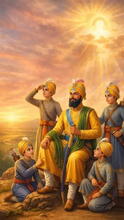
Guru’s four young sons, the Sahibzadas, lived with their parents in the city of Anandpur; Baba Ajit Singh, Baba Jujhar Singh, Baba Zorowar Singh and Baba Fateh Singh. They learned the skills of soldier, a saint, a scholar, and a statesman at the feet of their glorious father. Every evening they would gather their friends and practice the arts of swords and archery. As their skill grew, so did the love and pride of their father, Guru Gobind Singh. The two eldest boys took Amrit and joined the brotherhood of the Khalsa.
The Moghul rulers looked with disapproval on what was happening in Anandpur. The Sikhs were growing in strength and numbers. Emperor Aurangzeb feared that the Guru and his Khalsa would threaten his tyrannical rule in Northern India. He commanded that his generals to put an end to the Khalsa and raze the city of Anandpur.
The first attack on Anandpur Sahib was in the winter of 1695. The Guru called his 17-year-old son Ajit Singh and told him to hold the part of the city known as Keshgarh. He dispatched his other generals to defend the other forts around the city, and Bhai Daya Singh guarded the northern ramparts of the Anandpur Fort.
The brave Sikhs defended the city and drove the Moghuls away in a sound defeat. But this only hardened the emperor’s resolve and other wars followed between 1700 and 1704, the last one ending in a prolonged and brutal siege on the city.
The siege was bitter for the Sikhs, but costly to the imperial armies also. They were quickly exhausting the resources of the local area. But more importantly, through their lack of results, they were losing credibility with the Emperor in Delhi. The enemy generals formed a plan to induce the Guru to leave Anandpur by trickery.
Aurangzeb sent a message to the Guru assuring him a safe passage if he and his army would leave the city. He sent a signed copy of the Koran and pledged upon its pages that his promise was genuine. The Guru knew it was a trap and that the Moghuls would ambush them, but on the repeated requests of his family and advisors, Guru Gobind Singh agreed to leave the fort.
In the darkness of a night ravaged by storms on December 20, 1704, Guru Gobind Singh, his family and followers left the fort of Anandpur Sahib. The Punj Piare and other brave and devoted warriors accompanied the Guru as the front and rear guard. As they all reached the bank of the Sirsa River, they sat for morning prayer and Asa de Var at dawn. Thereafter, they plunged their horses into the freezing water.
When the Sikhs were mid-river, the imperial armies betrayed their promise and attacked them from behind. There was hard fighting in the darkness and cold rain. Punj Piara Bhai Sahib Singh and hundreds of brave Sikhs were killed in the battle. All the Guru baggage, including the holy manuscripts of the Adi Granth, were lost forever in the churning waters of the river Sirsa.
During the battle, Guru Gobind Singh was separated from his family. Mata Sundri and Mata Sahib Kaur made their way to Delhi, and stayed there in the protection of the sangat. The Guru’s mother, Mata Gujri had the two young Sahibzadas with her, and they made their way alone over rough terrain in the darkness.
As the sun rose on the 21st of December, Guru Gobind Singh and his two older sons, Baba Ajit Singh and Baba Jujhar Singh, rode together with group of about forty Sikhs with the Moghul army in hot pursuit. They took shelter in a small mud fort at Chamkaur and fortified it in preparation for battle. The Guru posted his men strategically on the roof, doors and windows. It was the firm resolve of each of the forty Sikhs to fight to the last drop of blood as the enemy amassed a hundred thousand troops on the horizon.
The Sikhs devised a new pattern for fighting. Six brave warriors, three pairs of two, would leave the fort and enter the battlefield. Each pair moved together back-to-back into the enemy ranks and fought furiously with their swords. With four arms and four legs, covering all directions, they were like a whirling ball of strength and steel. They fought bravely and amazed the Moghul soldiers with their skill and effectiveness, holding off the advancing troops. Swirling and slashing their swords, the few Sikhs wreaked mighty destruction amongst the enemy. Six by six, the Khalsa entered the battlefield including Punj Piare Bhai Mohukam Singh and Bhai Himmat Singh. The strategy worked, and the huge army could not take the mud fort during the entire day.
The Guru’s son, Baba Ajit Singh who was then 17 years old, placed his head on his father’s feet and asked permission to go forth and fight the enemy. Guru Gobind Singh understood this was their last meeting on earth. Smiling, that eternally loving father gave permission for his son to enter the battlefield. Baba Ajit Singh took with him five brave Sikhs and charged out from the safety of the fort. He fought with a fierce fury, and Moghuls fell beneath his powerful steel. When his arrows were spent and his sword was broken, Ajit Singh spitted the enemy with his spear. When his spear snapped, the enemy made a fresh attack and mortally wounded him.
The Guru, fighting from roof, said, “O God, it is You who sent him, and he has died fighting for his faith. The trust You have given me has been restored back to You.”
Baba Jujhar Singh, the Guru’s second son aged 14, on seeing his brother’s brave fight could not restrain himself and asked his father’s permission to join the battle. The youth took five more Sikhs with him and like his brother before him, created havoc among the seasoned enemy soldiers. It is written that Baba Jujhar Singh made his way through the mogul army as a crocodile through a stream. The enemy fell like rain in the monsoon until Baba Jujhar Singh and his five Sikhs also succumbed to the overwhelming numbers.
Punj Piare Bhai Daya Singh, Bhai Dharam Singh, and three other Sikhs came to Guru Gobind Singh and petitioned the Guru to leave the fort and let them stay and contend with the enemy. If at least the Guru survived, then, the seed of Sikhism will live on. The Guru was reluctant to leave his men in the heat of battle, but the Sikhs replied, “Beloved Guruji, we are not making a request, we are five Sikhs. By the power given to us on Baisakhi Day, we are giving you a “Gurumatta” which must be obeyed. You must leave this place.”
The Guru conceded and replied, “Wherever there are five Sikhs of mine assembled, they shall be the highest of the high. Whatever they do shall carry the authority of the Khalsa.” Saying this, the Guru walked around them three times and laid his plume and crest before them.
Sant Singh, who looked like the Guru in appearance, dressed in the Guru’s clothes, and waited in an upper room for the enemy soldiers. Bhai Daya Singh and Bhai Dharam Singh prepared to leave the little fort with Guru Gobind Singh. They planned to leave separately and walk towards a star that the Guru had pointed out in the night sky until they met again. The Guru took his bow and shot two arrows at the Turkish sentries who were holding torches, and they dropped their lights, plunging the battlefield into total darkness. In the confusion, the Guru and his companions silently left the fort.
In the morning, the moguls made a full assault on the little fort of Chamkaur. Sant Singh was in charge of the battle, and they inflicted great loss on the enemy. But eventually, the vastly superior numbers of the moguls prevailed. They succeeded in scaling the walls and finishing off the Sikhs. The moguls found Sant Singh, who wore the plume and dress of Guru Gobind Singh, and thought they had finally killed the Guru. But they were sorely disappointed to realize that Guru Gobind Singh had once again outsmarted them.
During the crossing of the river Sirsa when the Moghul armies ambushed the Guru, the younger sons of Guru Gobind Singh, Baba Zorawar Singh age 9 and Baba Fateh Singh age 7, were separated from the group in the confusion. They walked through the rugged jungle with their holy grandmother, Mata Gujri ji until they came to small village where they took shelter. An old servant of the Guru’s household, Gangu, heard they were there and came to Mataji. With sweet words he requested that they go with him to his village. He expressed care and concern, but his heart was dark with betrayal. Cold, wet and alone, Mata Gujri gratefully went with Gangu to his house. For a few gold coins, Gangu betrayed their whereabouts to the Moghul army. At dawn, a loud banging came on the door, and the soldiers of the evil governor Wazir Khan came to escort the holy family to Sarhind. As they traveled through the city, people thronged to see them pass offering words of encouragement. They shouted curses at the Brahmin and were shocked at the depravity of the Moghul governor.
In Sarhind, they were imprisoned in a tower that was unbearably cold in deep December. It was a barren cell with no cots or mats and just a pile of straw for comfort. Mata Gujri was strong knowing that the love of Guru was with them, but still she was wrung with anxiety for the safety of her young and innocent grandsons.
In the morning, the soldiers came to bring them to face Wazir Khan. When they came to the door of the Wazir’s palace. The huge gates were closed and only a very small servant’s door was open. The soldiers roughly pushed them to go through the door, but to do so they would have to bend over and duck down to enter. Baba Zorawar Singh saw the evil trickery of Wazir Khan, and said, “Brother, wait. See what this evil man is doing? We must bend our necks and bow our heads to enter through this little door. We are the sons of the 10th Guru, and we will never bow our heads to such a man!”
Even though the tension in the air was strong, Baba Fateh Singh laughed out loud. With a mischievous look, he turned his back to the door and scooted through backwards with Zorawar Singh close behind. Wazir Khan was furious when he saw that he had been out-smarted by a seven-year-old boy.
When they stood before Wazir Khan, even he was struck with their beauty. He offered to spare their lives if they would convert to Islam. If not, he proclaimed, they would be killed. Baba Zorawar Singh said in a loud voice, “My father is Guru Gobind Singh, my grandfather is Guru Teg Bahadur, and my great-grandfather is Guru Hargobind. Death means nothing to me. Our death will fan the flames that will drive all the tyrants from this land!” Their bravery and insolence in court shocked the governor. He ordered them tortured and killed, bricked alive in wall.
A soldier led away both the Sahibzadas. A large crowd had collected and the expressed their shock at the murder of such innocent ones. “What crime have they committed?” cried one. “How cruel and inhuman!” exclaimed another. “They are brave sons of their brave father!” said another.
The Sahibzadas were brought to a spot where a wall was being raised. Both were made to stand side-by-side. They started reciting Japji while the wall went up brick by brick. When the wall reached their chests, they were again offered life if they would convert to Islam. Lifting his head high, Baba Fateh Singh said, “We shall not give up our faith. We have taken the Amrit of the double-edge sword, so what do we care for death?”
The wall went higher and higher until both Sahibzadas became unconscious. At the tender age of 7 and 9, the two brothers died. Tears flowed from the eyes of the onlookers who watched this tragedy, horrible even for this regime known for persecution. They cried out in dismay, “What cruelty! Who shall answer for this crime!” Mata Gujri breathed her last on hearing the heartbreaking news and a wave of anguish gripped the country as the reports of the martyrdom of the Sahibzadas spread.
When Guru Gobind Singh was told of the death of his young sons, he took an arrow and thrusting it into the ground, pulling out a bush. He said, “Such a tragedy will not go unnoticed in God’s Court. Like this weed, the Mogul Raj will be uprooted.”
The Khalsa went on to survive the hardest of times and sprang back to life like spring water bubbling up from the ground. Under the inspiration of the Tenth Master, the Sikhs grew in strength and conviction, taking their place as the light of the world. The remembrance of the beautiful and brave Sahibzadas stays with the Khalsa through all times. Their bravery strengthens us, their sacrifice inspires us, and their love of Guru guides us. Their young lives set the example against which all other actions are judged.