By Shanti Kaur Khalsa
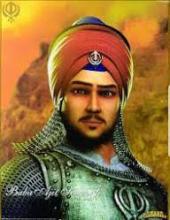
In the annals of Sikh history, few figures command the reverence given to the Sahibzade, the four great sons of Guru Gobind Singh. Among them, the eldest, Baba Ajit Singh Ji, stands as a towering figure of youthful valor and spiritual depth.
In April 1685, the young Guru Gobind Singh Ji traveled with his family from Anandpur Sahib to Sirmaur at the invitation of Raja Medini Prakash. Here he founded the town of Paonta Sahib on the banks of the River Yamuna, a place where the gushing waters of the river met the tranquility of lush green forests. The air was often filled with the harmonious blend of nature's melody and the chanting of holy scriptures, creating an atmosphere of peace, poetry, and music. Amidst great rejoicing, his first son was born here to Mata Sundari Ji on February 11th, 1687. Given the name Ajit, meaning unconquered, he was a prince by lineage and a saint-soldier by nature. He was a warrior whose life, though short, was defined by courage and a fierce commitment to justice.
From his earliest days, Baba Ajit Singh was raised in the martial atmosphere of his father, Guru Gobind Singh. He was trained in archery, swordsmanship, and horsemanship, skills he mastered long before adulthood. A defining moment in his life arrived when he was twelve years old on Baisakhi 1699. His father stood before a massive gathering in Anandpur Sahib and issued a thunderous call to arms, demanding that heads be sacrificed for the cause of righteousness. While the young Ajit Singh yearned to stand next to his father and offer his life then and there, he was held back by the gentle hands of his mother, Mata Sundari, who reminded him of his tender age. On that day he joined the sangat and drank the Amrit of the Khalsa, fully embracing bir ras, the heroic spirit that would define the rest of his life.
The Test of Battle - The Ranghars of Nuh
In 1699, shortly after the creation of the Khalsa, a group of Sikh sangat coming from the Pothohar region to see the Guru was attacked and looted by a group of Ranghars, a clan of Muslim Rajputs from the village of Nuh, located near Anandpur. When the news reached Guru Gobind Singh, he called Baba Ajit Singh to his side and asked him to protect the sangat. Though Baba Ajit Singh was only 12 years old at the time, he was able and strong. The Guru entrusted him with a detachment of 100 Singhs and sent him out with his blessing.
The young Sahibzada led the detachment to Nuh, besieged the village, and successfully recovered the looted property of the pilgrims. He returned the goods to the sangat and punished the bandits, marking his first successful independent command. From that point forward, he moved from his mother’s house at Guru ka Mahal and lived with the Guru’s army at the Fort of Anandgarh Sahib.
Proven in Battle —In Defense of Qila Taragarh
In preparation for the battles that were to come, Guru Gobind Singh fortified the city of Anandpur Sahib with five defensive forts. The most remote was Qila Taragarh, set high in the Shivalik Hills overlooking the hill kingdom of Kelur. Here, saintly people meditated day and night for the protection of Anandpur Sahib, while a detachment of soldiers kept watch over the city's eastern border.
In the heat of August 1700, the surrounding Hill Rajas began a massive assault on Anandpur Sahib, thinking to strike Taragarh first because of its remote location. Guru Gobind Singh sent a detachment from Anandpur to defend the fort, led by the young Baba Ajit Singh and the veteran warrior Bhai Ude Singh.
Despite being heavily outnumbered and very young, Sahibzada Ajit Singh led the defense with great bravery. The Sikhs utilized the fort's elevation to rain arrows and gunfire down on the advancing Hill armies. Under Ajit Singh’s command, the Sikhs successfully repulsed the attack, inflicting heavy casualties on the enemy forces and forcing them to retreat and abandon their plans.
This early victory was a massive morale booster for the Khalsa. It demonstrated that the Guru's son was not just a figurehead but a capable warrior in his own right. The success at Qila Taragarh was celebrated among the defenders with chants echoing through the air, singing praises to Waheguru. This triumph was seen not only as a strategic success but as a spiritual milestone, strengthening the resolve and unity of the Khalsa community.
A Brave Jethadar—The Rescue of a Brahmini
In early March 1703, a Brahmin named Devki Das came from Bassi Kalan to Anandpur Sahib in great distress to petition Guru Gobind Singh for help. With the cruel impunity of a tyrant, the local chieftain Jabar Khan had kidnapped Devki Das’s young bride as if she were mere property, shattering their new life.
By the age of 16, Baba Ajit Singh had grown from a boy into a respected jethadar and he no longer needed intermediaries to speak for him. He approached his father to request a command to rescue the Brahmini and Guru Gobind Singh entrusted him with a company of 100 soldiers. They rode out from Anandpur Sahib as night descended.
They surrounded the haveli of Jabar Khan and the air was thick with silence, broken only by the muffled clatter of horse hooves and the soft rustle of cloth as warriors adjusted their armor. The village of Bassi Kalan lay in serene darkness, unaware of the approaching storm. Suddenly, with precision and martial skill, they descended on the heavily guarded haveli. The raid was swift and surgical, overwhelming the guards, arresting the guilty chieftain, and returning the Brahmin's wife to her home unharmed.
After the thunder of the midnight rescue at Bassi Kalan, Baba Ajit Singh and his exhausted soldiers needed a place to rest and tend to the wounded. They stopped at a spot near the village of Bajrur, a place now known as Gurdwara Sri Harian Velan Sahib. 50 years earlier, the seventh Guru, Guru Har Rai Ji, had visited this exact location and stayed at the home of a devotee named Baba Prajapati. Bajrur was a dry area with no grass, and Prajapati dug up the roots of the creeping vines that were found in abundance in the area and brought them to feed the Guru’s horses. Touched by his devotion, Guru Har Rai blessed the land, declaring that the creepers and vines (vellan) would remain forever green (harian), and indeed, the vines grow green and in abundance still today.
When Baba Ajit Singh arrived with his troops in 1703, he found sanctuary amidst these same green vines. The shade of the trees and the spiritual resonance of the place provided a divine respite for the young warriors before they returned to Anandpur Sahib.
The Ultimate Sacrifice —The Battle of Chamkaur
In 1704, the Mughals were unable to defeat the Khalsa in battle and so laid a deadly siege on Anandpur Sahib. After many months, the people of Anandpur Sahib were starving and agreed to evacuate the city under Aurangzeb’s promise of safe passage. But while crossing the cold and dangerous Sarsa River, they were betrayed and their column was attacked by the Mughal army from behind. In the chaos of battle, the Guru’s family was separated. While the two younger sons and their grandmother crossed the river, Baba Ajit Singh and his brother stayed behind with the Guru. The rode at top speed, fighting to divert the Mughal forces from the refugees, and took shelter in the small mud fortress of Chamkaur Sahib.
Beleaguered, outnumbered, and now surrounded by thousands of enemy troops, the small band of 40 Sikhs prepared for their final stand. The Mughal forces aimed to crush the spirit of this defiant group and capture the Guru, numbering in the thousands and equipped with armaments far exceeding those of the Sikhs. The Sikhs, though only a handful, possessed unmatched courage and command over their limited resources. They went out two by two to engage the Mughal soldiers. Their tactic was to stand back-to-back and wield such fast and powerful swords that they could only be defeated by overwhelming numbers. In this way, they bought time for the residents of Anandpur Sahib to cross the river and reach the surrounding hills.
Baba Ajit Singh, then only 17, stood with his father and watched as Sikh after Sikh went out to bravely face death. Finally, he approached his father, asking for permission to enter the battlefield. Guru Gobind Singh did not hold him back. As written by Allah Yar Khan Jogi in his epic poem Ganj-e-Shaheedan, the Guru embraced him and said, "Go, my son, I entrust you to God. Die if you must but let no blow tarnish the glory of your dignity."
Historical accounts describe his final moments as a storm of blinding brilliance. Baba Ajit faced the enemy army and in a booming voice, challenged them to a single battle. No one dared come forward to fight him one-on-one. He unleashed his fury and fought with the skill of a veteran general, his arrows piercing the enemy ranks until his quiver was empty. When his spear broke inside the armor of an adversary, he drew his sword and fought until he was overwhelmed by the sheer numbers of enemy soldiers who advanced on him. It is written that Baba Ajit Singh cut through the enemy like a lion among sheep, his resolve unshaken even in the face of insurmountable odds. He fell as a martyr, under the blessed gaze of his father, who called out to the One to welcome Baba Ajit Singh back home.
Baba Ajit Singh remains through time the epitome of the saint-soldier, a youth of great spiritual capacity who combined the tenderness to rescue the helpless with the courage to face the wrath of a brutal empire alone. As we reflect on Baba Ajit Singh's legacy, let us consider how we can embody his principles of courage, integrity, and compassion in our own lives and time. How can we stand up for justice in our communities and live with the same spirit of dedication to righteousness? His life invites us not only to remember his heroic deeds but to transform our admiration into action by carrying forward his legacy of courage and service.