By Shanti Kaur
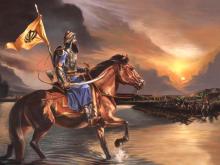
The Battle of Sirhind began on May 12, 1710, at Chappar Chiri, a meadow about 20 kilometers from Sirhind. At first light, the irregular Khalsa troops under the command of Banda Singh Bahadur stood against the professional and orderly Mughal cavalry under Wazir Khan. The battle began with thunderous Mughal cannon fire meant to weaken the Khalsa lines. Lacking artillery, the Khalsa suffered heavy losses at first and the men hesitated. Banda Singh Bahadur climbed a hillock to survey the field and rally his men. He then galloped into the heart of the fight roaring “Fateh Darshan!” as he led a bold charge that inspired his men onward. The uneven terrain of mounds and shrubs gave the provisional Khalsa foot soldiers tactical advantages and all at once the battle intensified.
Banda Singh Bahadur was no ordinary man, and Sirhind was no ordinary place. Five years earlier, on December 26, 1705, the two younger sons of Guru Gobind Singh Ji Maharaj, Sahibzada Zorawar Singh (age 9) and Sahibzada Fateh Singh (age 6), were brutally murdered here. After being separated from their father during the evacuation of Anandpur Sahib, the young Sahibzadey were captured along with their grandmother, Mata Gujri. When brought before the Mughal governor, Wazir Khan, and told to convert to Islam, they stood firm, unwavering in their courage and their faith. In a ruling viewed as inhuman even then, the children were sentenced to death and brutally bricked alive. Their martyrdom, marked by innocence and courage under unimaginable pressure, stands as one of the most moving examples of fearlessness in Sikh history.
Banda Singh Bahadur's return to Sirhind in 1710, two years after Guru Gobind Singh’s death, marked a turning point in Sikh history. The Khalsa transformed their grief into victory, rising up against a ruthless oppressor.
From Yogi to Warrior
Banda Singh Bahadur was born Lachman Dev, the son of Rajput farmers in Jammu in 1670. As a young man, he gravitated toward archery and hunting, renowned for his swordsmanship. One day, while hunting, he shot an arrow that struck down a deer. Approaching his kill, he saw the arrow had split open the doe’s womb, exposing two lifeless fawns in bloody stillness. Overwhelmed and horrified, he was deeply shaken by the suffering he had caused. From that time onward, he resolved to live as a renunciate, away from the world.
In his teens, he left home to search for peace. During his travels, he met sadhus and teachers and was initiated as a Nath monk, a bairagi, taking the name Madho Das. He lived a solitary life of meditation and tapasya, becoming an accomplished yogi of great power. He built his ashram in the jungle outside Nanded, on the Godavari River.
Meeting his Guru
In September 1708, Guru Gobind Singh and the Khalsa traveled through the Deccan alongside Emperor Bahadur Shah as he sought to consolidate his realm. After making camp in Nanded, the Guru heard of this formidable ascetic and sought out his ashram. Guru Gobind Singh and his men arrived at Madho Das's retreat. September 3rd marked a solar eclipse, and the Guru anticipated Madho Das might be absent. The Guru entered the ashram without permission, asked his men to take over the kitchen and prepare food, and sat on the Bairagi’s gaddi, his sacred meditation seat.
Although he was not there, Madho Das was a yogi and a tantric, and his sensitive field detected the armed men's intrusion. The Yogi was furious! How dare these strangers defile his meditation space! In ego and anger, he summoned his psychic powers to overturn the charpoy on which the exalted Guru sat and dump him on the ground, a minor feat for such a great yogi. He focused his mind like a lightning bolt, but nothing happened. He tried again with all his effort, and the legs of the cot shook with energy, but his tantric projection was no match for the radiant glory of Guru Gobind Singh. Recognizing the Guru’s superior spiritual strength, Madho Das hastened back to his ashram in ecstatic joy. Finally, the Guru he had longed for his entire life had arrived!
On seeing the resplendent Guru Gobind Singh, Madho Das fell on his knees before his master and cried with an open heart, "Main Tera Banda." I am your slave!
“If that is the case, my Banda Singh,” the Guru replied, “then come with me and join the Khalsa.”
Without hesitation, Madho Das Bairagi agreed, walking out of his ashram without a backward glance and following the Guru back to camp in Nanded. Within only a few weeks, he embraced the Khalsa bana and discipline and immersed himself in Gurbani. He took Amrit and was given the Khalsa name Gurbaksh Singh, although Guru Gobind Singh and the sangat continued to call him Banda Singh Bahadur.
Towards the end of September, Guru Gobind Singh knew his time on earth was coming to an end and he called Banda Singh Bahadur to his side. He held Banda’s face in both his hands and asked him to do the hardest possible job – to lead the Khalsa in the tumultuous time that was surely to come following his death. He gave him 5 arrows from his quiver as proof to the sangat that Banda came under the Guru’s Hukam – Guru Gobind Singh’s arrows were unique in that they were tipped with pure gold, a small measure of support for the widows of the ones felled by his unerring bow.
The Path to Sirhind
With five Khalsa to accompany him, Baba Banda Singh Bahadur left Nanded just days before the passing of Guru Gobind Singh. As Banda Singh Bahadur marched northward, his army swelled with men eager to fight again under the Guru’s banner. It was a diverse mosaic of soldiers: devout Sikhs seeking to uphold the Guru's legacy, oppressed peasants tired of heavy taxation, and even opportunistic mercenaries. By the time they reached the borders of Sirhind in May 1710, the Khalsa force was a formidable, albeit irregularly equipped, revolutionary army.
Wazir Khan, the Faujdar of Sirhind, was the man responsible for the cold-blooded execution of the Guru’s younger sons, Sahibzada Zorawar Singh and Sahibzada Fateh Singh. He prepared for the encounter with the full might of the Mughal state, including long-range artillery, a disciplined cavalry, and war elephants.
The battle took place on May 12, 1710, at the field of Chappar Chiri. The fighting was hand-to-hand and ferocious on both sides. The Sikh soldiers, driven by the memory of the young Sahibzadey, fought with a "do-or-die" intensity that unnerved the Mughal regulars. The battled finally turned when Wazir Khan himself was knocked from his horse. In the fighting he was killed and the Mughal army, seeing their leader fallen, broke ranks and fled. The Khalsa relentlessly pursued the Mughal soldiers and stood victorious on the battlefield.
The Fall of Sirhind and the New Order
Two days later, on May 14, the Khalsa entered the city of Sirhind. Unlike the Mughal conquests of the time, which often resulted in the wholesale enslavement of the population, Banda Singh Bahadur freed the city. His primary objective was the dismantling of the administrative machinery of oppression.
This victory was not merely military; it signaled the rise of Sikh sovereignty and a radical reordering of society. Banda Singh Bahadur abolished the oppressive zamindari system, granted land ownership to the tillers, and struck coins in the name of the Guru, embodying the Khalsa ideal of righteous rule grounded in justice, equality, and the fearless defense of dharma.
The victory at Sirhind shattered the myth of Mughal invincibility for all time. While the Sikh state established by Banda Singh Bahadur was eventually suppressed by the sheer weight of the Mughal Empire, the seeds of sovereignty had been planted. This victory provided the psychological and military blueprint for the Sikh Misls and, a century later, for the Empire of Maharaja Ranjit Singh.