By Shanti Kaur
In the Sikh tradition, Gur Prasad is at the core of our existence. It is the word in the Mool Mantra before the command Jap, the root teaching with which Guru Nanak Dev Ji begins Japji Sahib and the Siri Guru Granth Sahib. The mantra teaches us that the Formless One is the Creator, without fear or enmity, timeless, unborn, and self-existent. Then comes Gur Prasad—by the Guru’s grace. It tells us that the Divine Reality described by the Mool Mantra cannot be grasped by intellect alone. It is known through grace, through the light and wisdom of the Guru.
The term Gur serves as a theophoric prefix meaning "belonging to the Guru," sanctifying any noun it precedes. Prasad translates to "grace," a divine gift or blessing that cannot be earned but can only be received. Together, "Gur" and "Prasad" mean the "Divine grace of the Guru."
Gur Prasad does not mean that human effort is unimportant. We rise early in the morning, meditate on Naam, recite bani, engage in honest work, and serve others. Yet, as many of us have experienced, a strong sadhana does not automatically result in liberation. Sadhana prepares the ground; but it is grace that causes the seed to bloom into a flower. We open our heart through Sadhana, but it is the Guru who bestows the gifts of understanding and the experience of union with the Divine.
But who exactly is the Guru through whom this grace is known? Guru Nanak answers this question in the Rahnuma Sakhi, an account of his travels in Afghanistan.
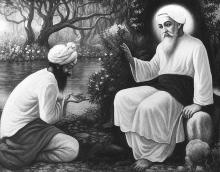
While early stories known as the Janam Sakhis tell of Guru Nanak’s journeys to Mecca and Baghdad, the 19th-century text Twarikh Guru Khalsa (1892), records other journeys. These stories were written by Giani Gian Singh, drawing on oral traditions preserved since the time of Guru Nanak. They provide wonderful details that were missing from the Janam Sakhis, such as this story of Guru Nanak’s Fourth Udasi, his extensive teaching journey through Kabul and Kandahar. The account appears as the Rahnuma Sakhi, in the chapter Udasi Chauthi.
It is written:
“When the Guru arrived in Kabul and Kandahar after visiting Mecca and Medina, the Guru engaged in goshti (spiritual discourse) with Muslim fakirs and Sufi saints. Impressed by the Guru’s luminous presence, a renowned Sufi dervish from Kandahar came with all his followers and asked directly, ‘Tera Rahnuma?’ (Who is your guru-guide?)
“Guru Nanak replied simply and kindly: ‘Khuda-e-man.’ (The Formless One is my Guru.)
“Hearing this, the dervish bowed at the Guru’s feet in ecstatic wonder.”[i]
Guru Nanak’s response, Khuda-e-man, affirms that the ultimate Guru is the Divine One—the source of all wisdom, guidance, and light. This is the Guru we call upon when we recite Ong Namo, Guru Dev Namo.
His answer does not diminish the sacred office of the Guru; rather, it reveals its primal origin. The ten Gurus carried the one Light moving through the Guru’s form and word. The same Jot passed from Guru to Guru and was bestowed upon the Siri Guru Granth Sahib by Guru Gobind Singh. When a Sikh bows before the Guru, the bow is not to paper and ink, but to the living Shabad and the sacred wisdom it conveys. Gur Prasad is the grace by which that wisdom moves from something we read or hear into something that penetrates and uplifts us.
Ik Ong Kar Satgur Prasad appears in the Siri Guru Granth Sahib 524 times as a Mangla Charan, a sacred invocation placed at the opening of a composition or section. It may be understood as: One Creative Reality, by the Grace of the True Guru. Before the Shabad unfolds, the Mangla Charan establishes its spiritual authority: that the One is revealed through the Guru’s Grace. Each repetition returns the reader to humility when we enter the presence of the Guru and ask that the meaning be opened within us.
In our lives, Gur Prasad can be received as an awareness. Guru’s Grace may arrive as the longing to meditate, the courage to change, the timely word that restores our direction, and the unexpected softening of the heart. It may also appear as a difficulty that breaks our pride and returns us to what is true. We recognize it when we are willing to listen, serve, and give thanks. The words Gur Prasad invite us to live with humility and trust: to do what is ours to do, while remaining open to the wisdom that cannot be earned, only given.
[i] From the upcoming book from Hargopal Kaur and Shanti Kaur–Mantra Wisdom: Practices for Conscious Living from the Teachings of Yogi Bhajan.