By Shanti Kaur Khalsa
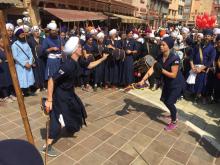
The thunder of horses echoes across the field as the young Nihungs come forward at a full gallop. Ducking the spray of dust that sprinkles the watching crowd, you can’t help but look on in appreciation and wonder at the bold riding and intrepid battle skills that are still cultivated by the brave warriors of the Guru. Each year on the first day of the lunar month of Chet (the first month of the Sikh calendar), which is March 4th in 2026, the Sikhs of the Guru celebrate Hola Mohalla. First originated by Guru Gobind Singh Ji Maharaj in 1701, Hola Mohalla is still today a grand celebration of mock battles, exhibitions of horsemanship, display of weapons, and a grand procession throughout the city of Anandpur Sahib in praise of the Guru.
By the year 1700, the City of Anandpur had been the target of several attacks from the neighboring hill chiefs. The greatness and growing influence of Guru Gobind Singh, who commanded increasing military strength, formed alliances with local communities, and controlled key trade routes in the region, stirred the hill chiefs to jealousy and fear. After the Amrit of 1699, young men from all over the Punjab poured into Anandpur for the chance to serve in the Guru’s army. Guru Gobind Singh, knowing what lay ahead, kept himself ready for defense, knowing that battles would come soon. He issued a hukamnama that all Sikhs who came to see him should bring weapons as gifts. He preferred steel over gold and prized bravery above all things.
Meanwhile, in response to the growing might of the Khalsa, the hill chiefs became increasingly uneasy about their own security. This mounting strength prompted them to petition the Mughal empire for reinforcements. In due course, two Panjhazari Mughal commanders, Painda Khan and Din Beg, were dispatched from Aurangzeb to bring Anandpur under occupation. By June of 1700, the Khalsa faced an army of 10,000 soldiers and fought the first battle of Anandpur Sahib. Though estimates of the Khalsa’s numbers vary, it is believed that their forces numbered around 2,000 at the time, standing together against an enemy that outnumbered them five to one. Throughout the engagement, the Sikhs fought with skill and courage, constantly pushing the enemy back from the boundaries of Anandpur Sahib.
Seeing the determination of the Sikhs, Painda Khan challenged Guru Gobind Singh to single combat. Painda Khan taunted the Sikhs, saying the Guru should take the first shot since that may be his last. The Guru replied that he would never strike except in self-defense and invited Painda Khan to deliver the first blow.
The air changed. Silence. Two arrows hissed from Painda Khan's bow. The first sizzled by the Guru’s turban. The second arrow blew by so close that its tail feathers brushed the Guru’s chola. Time seemed to stretch in the dust between them. Now it was the Guru’s turn. Painda Khan was encased in heavy armor from head to foot, feeling safe behind sheets of hammered metal. With a quick pull of his bow, the Guru shot a single arrow. It flew cleanly into an exposed point near Painda Khan’s ear, blowing him backwards, lifeless from his horse.
The Mughal soldiers were furious at the death of their commander and charged into the ranks of the Sikhs, but they were effectively pushed back. The Sikhs routed the enemy and pursued them all the way to Roper. The Guru was gratified to see his Sikhs stand with such firmness amidst the fury of battle and offered a prayer of thankfulness upon returning to Anandpur. Throughout the celebrations in the city, the Guru alone knew that this was the first of many battles, and the test of the Khalsa’s mettle was still to come.
The spring of 1701 brought a brief period of peace in Anandpur. To keep the “ Bir Ras,” the martial spirit, alive in the ranks of the army, Guru Gobind Singh called all the Khalsa to come to Anandpur for a parade and battle drill. The day he set was the day after the Hindu holiday of Holi – the Festival of Colors. Holi is celebrated throughout India, commemorating the victory of Prahlad’s faith when Narayan appeared as a man-lion and killed the evil king Harnaakash.
As the holiday is called “Holi,” the Guru declared the day after as “Holla,” the masculine form of the word. He set the next three days as non-stop action, with Sikhs demonstrating their bravery and skill. A mock battle, personally supervised by the Guru, was carried out on the dry river bed of the Charan Ganga with the Naina Devi peak in the background, lifting high on the horizon.
The peace did not last long, and the Khalsa fought five more brutal battles against the Mughal army. In 1704, the City of Anandpur was evacuated under false promises of peace from Aurangzeb. Against all odds, and enduring unspeakable hardship for which our eyes weep even today, the Khalsa fought during those years with great nobility and dignity.
Since that lovely spring in 1701, before the years of sacrifice seasoned our spirits, the Guru’s soldiers have returned to Anandpur for a show of martial spirit on Holla Mohalla. To honor and celebrate those days of youth, the Nihungs gather at Guru Ka Lahore, where Guru Gobind Singh and Mata Jito ji were married as children. Over the three days of Hola Mohalla, games are held at the Charan Ganga, music and poetry competitions fill the city, and the last day is a full procession throughout the streets of Anandpur Sahib. It is a time of innocence, of rejoicing, and of celebrating the martial spirit of Guru Gobind Singh, reminding us all to remain in readiness for whatever the future holds.