By Shanti Kaur
The late seventeenth century was a brutal time in India. The world had the noose of the Kali Yuga around its neck, the age of darkness, and it was pinching deeply. It was a time when sitting next to someone of a higher rank could mean death. Dozens of common people could be seized at the whim of a local ruler, their blood fed to the emperor’s hounds. This was the existence in Bharat. The price of life was cheap, and in matters of life and death, there was no court of appeal.
Into this environment, Sikhism emerged as a ray of light. Guru Nanak Dev Ji brought hope and dignity to a people in crisis. His message of universal love was received like rain in the desert. In 1666, Gobind Rai was born and later became the 10th Guru of the Sikhs, the great Guru Gobind Singh Maharaj. His path was unique. He took human birth with the focused intent to challenge the tyrants and uproot the evil-doers who terrorized the people. He writes in his autobiography:
“I came to this world with a mission,
The Lord delegated me to the cause of righteousness.
Go and spread Dharma here, there, and everywhere,
And defeat the tyrants and evil persons.” (42)
~ Guru Gobind Singhji, Bichitra Naatak – Apnee Kathaa
Guru Gobind Singh faced a challenge unequalled in history. He needed to transform a spiritual community of devotees, poets, and gentle meditators into an invincible army. They would have to challenge and defeat the brutal Mughal regime. His grandfather, Guru Hargobind Sahib, had laid the path of Miri Piri: temporal and spiritual mastery. Yet, it was Guru Gobind Singh who made it possible for all people to walk this path.
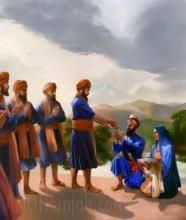
On the 13th of April, Baisakhi 1699, Guru Gobind Singh created the brotherhood of the Khalsa. This event, a dramatic display of leadership, unfolded before a gathering of 80,000 people. After unsheathing his sword, he called for any Sikh to come forward and give his head to the Guru. Leaning forward, the Guru searched each face. In an unforgiving voice, he boomed, “I need a head! Who is willing to satisfy the calling of my sword?” The crowd was stunned into silence; they had never seen the Guru in this mood before.
Daya Ram, a shopkeeper from Lahore, startled even himself when he stood and moved to the stage. The intensity in the Guru’s body drew him like a magnet. His heart pumped so loud he could hardly hear his own voice as he replied: “Guru Sahib, my head is yours.” He moved through the crowd to the stage. There, he folded his hands before the Guru. Guru Gobind Rai took him by the arm and, with a fierce glance over his shoulder, led him into a tent at the rear of the stage. Moments later, the Guru strode back onto the stage, his sword dripping with crimson blood.
A gasp spread through the sangat as the Guru walked to the platform’s edge. He raised the wet sword over his head and roared, “I need the head of another Sikh. Is there any among you who will quench the thirst of my sword?” If there was any confusion at first, it was now clear the Guru was beheading his Sikhs! Panic stirred among the crowd and some people silently slipped away.
However, Dharm Das, a Jat from Delhi, came forward in total devotion and grace. He was followed by Himmat, a water bearer from Jagannath; Mohkam Chand, a washerman from Dwarka; and Sahib Chand, a barber from Bidar, Karnataka. One by one, they went into the tent with the Guru, and the Guru came out alone.
No one was prepared for what happened next: The Guru led the five beloved ones from the tent, alive and well, dressed in beautiful clothes and dazzling in spiritual radiance. The Sikhs were ecstatic and the crowd swelled forward. In the days that followed, tens of thousands of Sikhs took Amrit and pledged their lives to Guru Gobind Singh. The brotherhood of the Khalsa was born, emerging with a unique and irresistible identity.
Among the most powerful transformations of the Khalsa was the legacy of Guru Gobind Singh known as Chardi Kala - the soaring of the human spirit to a higher plane, an unshakeable exaltation that defies every shadow.
The concept of Chardi Kala allowed Sikhs to transform from common people to Warrior-Saints. Chardi Kala is a simple yet sophisticated spiritual state. In Chardi Kala, the Creator’s Will is the only true reality; in that reality, there is no sadness, regret, or depression—none of the negative feelings that engulf mankind. When those feelings command a person, he feels small and incapable. However, without those emotions, anyone can rise to become a formidable Warrior-Saint. As explained by the Siri Singh Sahib ji:
“Yesterday is gone, but you can be miserable by the memory of it. It won't do you any good. It is yesterday and it is already gone. Even today it is going. You can't stop it. You can only welcome tomorrow in the name of the goodwill of all beings, the Grace of Guru, and the consciousness of God. That is the only positive way to live, and that is the alphabet of a Sikh. It is called ‘Chardi Kala.’
“Chardi Kala is simple: Welcome tomorrow, forget yesterday, and do so with perpetual endurance. God gives you the breath of life for tomorrow; if that breath is true to you, be true to it. When you consciously welcome tomorrow, ‘Ang Sang Wahe Guru’ happens.” ~ Yogi Bhajan 3/10/1991
Guru Gobind Singh lived in the ecstasy of Chardi Kala all the days of his life.