By Shanti Kaur Khalsa
When I arrived at Hacienda de Guru Ram Das, it was the fall of 1974. I was picked up the night before at the bus depot in Albuquerque, and took the long, lonely drive to Española. It was a dark night, and not a thing could be seen stretching on either side of the narrow road. No cars were on our side of the road as we drove north, and no cars passed us heading south – so it seemed like hours of driving with the highlights shining into empty blackness.
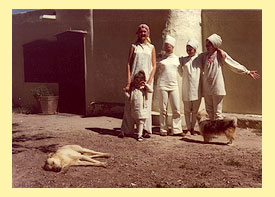
But daylight proved me wrong. The ashram was alive with activity. They ate their meals together, and I joined the group for breakfast outside the “main house.” In the spot where the Gurdwara now stands were two tall Chinese elm trees shading some picnic benches with about 25 young people eating breakfast. Some had turbans, some did not, but everyone had long hair and skinny limbs. The boiled wheat berries and milk that was served for breakfast certainly contributed to the general good health, but edgy attitudes.
There was no cost for living and eating at Hacienda de Guru Ram Das, but everyone was expected to work as they were assigned. Some people stayed in Española and worked the land or helped in the community kitchen. But most of us traveled to Santa Fe every day to work at the Golden Temple Restaurant – which is now Pasqual’s on Water Street – either as cooks, dishwashers or waitresses. The best thing about working at the restaurant was that it was the only opportunity to eat as much as you wanted.
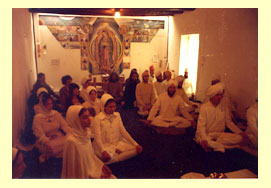
In 1974, the Main House was the center of activity. Wha Guru Singh and Wha Guru Kaur were the ashram leaders, and they lived in a single room where the receptionist office is now. Gurumukh Kaur and her husband lived in the little room which now holds the Xerox machine. Papaji, the Siri Singh Sahib’s father, lived in the room next to that. The Ashram Office was across the hall and that’s where I lived and worked – keeping my clothes and sheepskin under the desk during the day and sleeping on the floor at night.
Down the hall was the only bathroom in the building, the kitchen was on the right - where Sikhnet is now, and the sadhana room was on the left. There was no mural yet, but it was in process and the niche had already been constructed for the Akhand Path which occurred twice each week, back-to-back. At the end of the sadhana room, which now opens into the Gurdwara, was a lovely kiva fireplace with a gigantic picture of the Siri Singh Sahib, a.k.a. Yogi Bhajan, over the mantel.
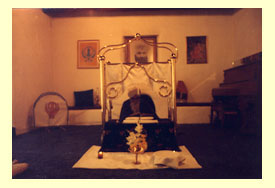
The ashram actually began in Santa Fe in early 1971. Camped in tents on Aqua Fria Street, this little hippy community was led by Dawson and Karen, and was populated by young people who were fully dedicated to “alternative living.” It was a typical scene in Santa Fe in the sixties and seventies, with one big difference. This group did sadhana together in the field every day around a campfire.
By November, the weather had turned cold and Dawson and Karen were ready to move on. In the terminology of the time, they “freaked-out and left the path.” The small group of students, under the leadership of Wha Guru Singh suddenly found themselves without a place to live so they did what everyone did in those early days – they called Yogiji. This was the privilege of every student – to pick up the phone, make the call, and hear that deep warm voice at the other end who always answered “Sat Nam.”
Yogiji said that the group must stay together. He told them to drive north and find a place where the sun was shining on a house – that was to be their new home. He gave them kind words of assurance that God and Guru would guide their destiny. Of course, no one had a car. So Yogiji asked an old friend to drive them, someone who had helped him the summer before as well, the intrepid Frenchman, Robert Bossier. (Robert has since left this earth, but not before building his own home which is now the wonderful Gabriel’s Restaurant.)
With enthusiasm they drove north to look for a new place for the ashram. It was a cloudy day, unusual in New Mexico in the Fall, but they traveled on in full faith because if “Yogiji said it," then it must come true. As the car passed through Arroyo Seco and started up the gentle hill on the way into Española, the sun suddenly and dramatically pierced through the clouds. A shaft of light beamed down to earth off the road on the right like a sign from God, Himself. Clearly, that was the place to turn and the little group left the main road at the junction of Route 106.
The house they found was the only place the sun was shining on that day. It was a humble farmhouse with a barn located on a little over six acres of land. The belabored old building dated back to the turn of the century and looked every year of it. The walls were thick adobe and some of the floors were hard-packed dirt, but there was a good roof, electricity and running water. It was perfect. When they asked the old couple who were living there if the house was for sale, it took them by surprise. It had never occurred to them that someone would actually want to pay money for their dry farm. When they saw that this group of strange young people was serious, they immediately agreed and named their price - $24,000 for house, shed, barn, and six acres. Yogiji borrowed $10,000 from one of the yoga students, which he later paid back from his own money, and borrowed the rest from Valley National Bank.
There was a large, dirt-floor room used for apple storage. The young Sikhs laid carpet right on the dirt and it became the Sadhana room. A dirt-floored room for vegetable storage became the men’s room, and across the hall was the ladies dormitory room. The simple kitchen soon became the heart-center of the new ashram where community meals were cooked and hot Yogi Tea filled the short evenings. Behind the house were thousands of old tires in giant piles along with several wrecked cars that needed to be disposed of. The group went to work, and the house transformed into the Guru Ram Das Ashram.
“God guided us to Española, and that is why I have always said that this place never belongs to any person. It belongs to God because we would never have thought of getting it, and we had no means to get it. It was given to us. Therefore it is a gift of God and Guru.” (the Siri Singh Sahib, Beads of Truth, Fall 1975)
By the time I arrived in 1974, the ashram had outgrown the little house and the single men had moved into the dilapidated barn. In the barn, there were no major renovations, no heat and no privacy. But none of the men were spending much time in the barn because there was plenty of work to be done and no time to rest. The ashram had expanded into a couple other small neighboring properties, and the land had swelled to 20 acres. A cute little building was bought in 1974 for the Siri Singh Sahib to live in, nestled into a grove of tall and shady cottonwood trees on the banks of the Santa Cruz River. It was named the “Gold House” because of its bright yellow stucco. the Siri Singh Sahib and Bibiji did stay there a couple times, but then in 1977 it became a dormitory for their two younger children, Kulbir and Kamaljit, and other school children who came from all over the country to live in Española and attend McCurdy High School.
At Hacienda de Guru Ram Das, the drama of religious art was unfolding. The sadhana room held an ethereal mural depicting the Virgin Mary of Guadalupe surrounded by the ten Sikh Gurus, scenes from their lives, the Golden Temple, and the devout Juan Diego on his knees beholding the lovely Lady of Guadalupe. Completed by the celebrated artist Edward O’Brien in 1975, this outstanding work of art is today the east wall of the Siri Singhasan e Khalsa Gurdwara.
Mr. O’Brien had been well known to the Sikhs since the early days of the Guru Ram Das Ashram. In his studio in Santa Fe, he had many moving religious discussions with them and was inspired by their devotional and energetic approach to life. Through the process of his own internal growth and path of self-discovery, he conceived a work of art that combined his love for the Lady of Guadalupe with the lives and ethics of the Sikh Gurus. He painted one version in 1972 and gifted it to the Siri Singh Sahib. This hangs today in the Secretariat in Los Angeles. He started the mural in 1973 in his studio in Santa Fe, and moved it along with himself to the ashram in 1974. He lived in the building we now know as the archive building, which was named Shanti Nivas. The mural was finished in the spring of 1975, and he had planned to travel to India in the coming fall to see the Golden Temple for himself. To the deep sorrow of the ashram, Edward O’Brien died of a heart attack at home one week after the mural was finished.
In the spring of 1975, a rustic ranch was purchased as a Sikh Dharma training center and guest house for Sikh Dharma International. Sitting under three beautiful cottonwood trees on over 20 acres of fields, “the Ranch” was soon to be the home of the Siri Singh Sahib whenever he visited Española – which now was about four times each year. Behind the ranch house, a simple geodesic dome was constructed as a private meditation room for the Siri Singh Sahib. This unique structure was designed and built by the humble hands of Guru Meher Singh – husband of Guru Meher Kaur and father of Guru Darbar Singh. With love and devotion, he worked into the late hours of the night anxiously trying to complete the building before the Siri Singh Sahib returned to New Mexico for Summer Solstice. With the whole ashram at work, they created it as a labor of love. It was in that dome, twenty-nine years later, that the Siri Singh Sahib breathed his last breath on this earth.
By the mid-seventies, the sangat had grown so large it was hard to find places to hold Summer Solstice Sadhana. The Siri Singh Sahib wanted to buy some land and for months different sites were considered, but nothing we looked at seemed just right. One day, in the spring of 1977 when the Siri Singh Sahib was visiting New Mexico, he was returning home from Santa Fe when he told his students to keep driving and they went on through Española. He told them to turn left up this winding dirt road that led into the mountains. After several miles of steep driving, they crested onto a flat stretch of road, and he was struck with the beauty and simple, spiritual grace of the Pajarito Plateau. Standing majestically at an altitude of 7,500 feet, the land had a sweeping panoramic view of the snow-capped mountains and surrounding valleys. When the Siri Singh Sahib looked out over the land, his gaze was held in rapt attention, for he saw a scene that the other people in the car could not behold. In the skies above the plateau he saw a huge gathering of luminous angels, the sight of which stunned him, and confirmed that this land was the place he had been searching for.
Most of the land in that area was owned by the Santa Clara Indians or by the Federal Government - the BLM. They stopped an old truck traveling towards them down the dirt road, and asked the driver if there was any private land in the vicinity. As it turned out, the man was a rancher who owned one of the few parcels of private land, situated at the high point of the plateau. After several rounds of earnest bargaining and negotiations, an agreement was reached on May 13 to purchase the 160 acres of land, as long as water could be found under the arid desert.
However, finding water in this mountainous region was not easy. Geologists were hired to evaluate the land, but they could make no definitive recommendations for drilling. A local water diviner was brought in, but even he could not find a place where subsurface water existed. Undaunted by these pessimistic reports, the Siri Singh Sahib selected a place and the driller set up his rig. After several weeks of drilling, many broken drill bits, and patience that nearly expired, an abundance of clear, clean water was found at a depth of 880 feet. Deep below the normal aquifer ran a subterranean river of exceptional purity. The purchase was joyously finalized, and the beautiful land was named “Ram Das Puri.”
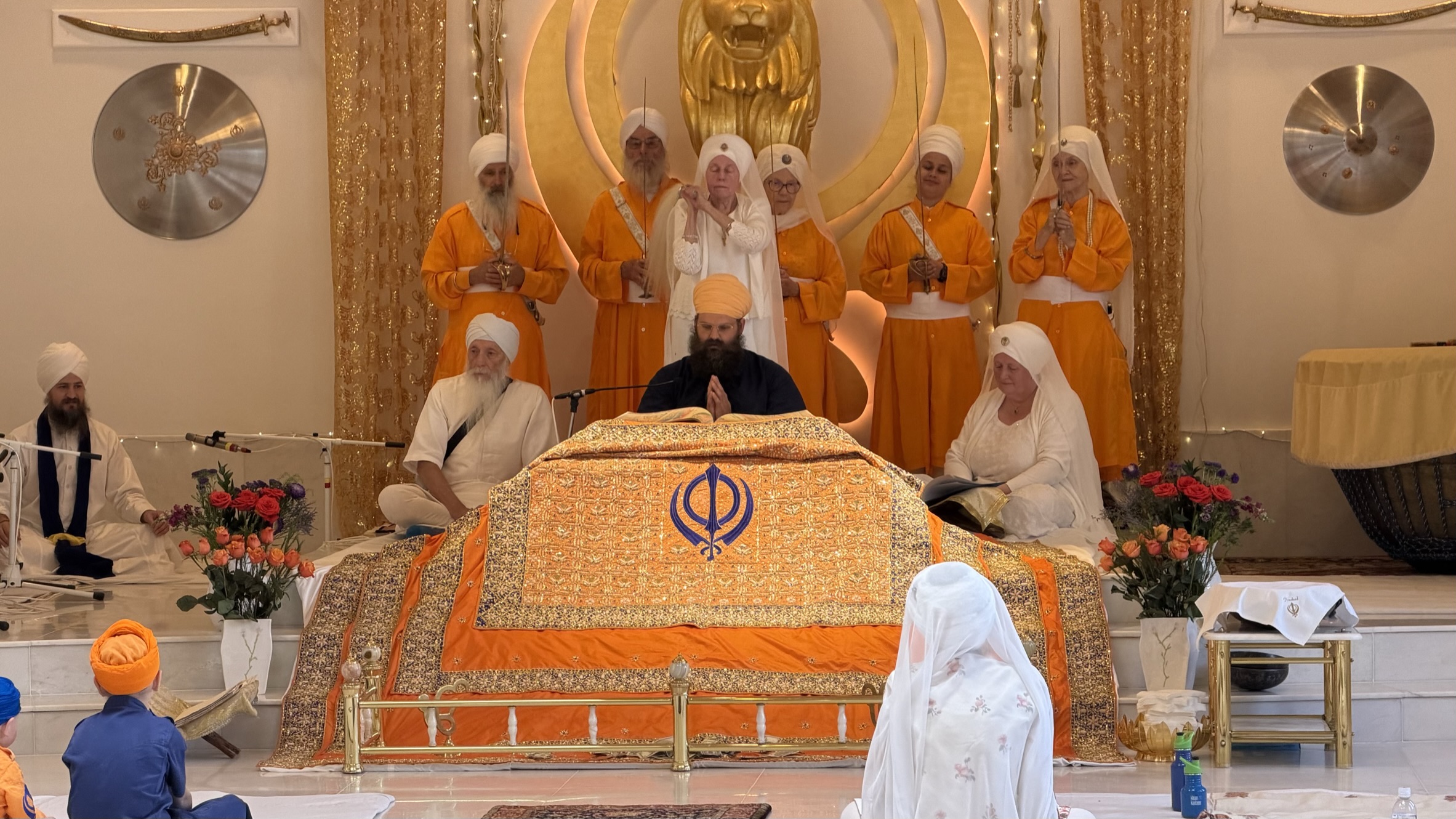
In the fall of 1989, plans were made in Española to expand the main ashram building into a gurdwara. Years earlier the sangat had become too large to hold gurdwara service in the sadhana room, and they had utilized a temporary building for that purpose. When Mukhia Singh Sahib Dr. Guruchander Singh Khalsa brought the idea of building a gurdwara to the Siri Singh Sahib said, he said, “OK, I give you my blessings to do this. But I want to see the plans within seven days!” The plans were hastily produced, but the Siri Singh Sahib was not totally satisfied. He told them they had to crown the building with a gold dome. No one had the money or the expertise to produce such a dome, so the Siri Singh Sahib was told it was impossible.
Construction on the gurdwara began immediately. All the work was done by people in the sangat as seva, and funds for materials were donated from all over the world. The building rose from the ground with tall walls and a giant beamed ceiling. One day in October at 2:00 AM, they broke though the adjoining wall, opening the old sadhana room into the grand hall of the new gurdwara.
Again and again, the Siri Singh Sahib insisted that a gold dome must be built, and again he was told it was impossible. The fourth time he asked, Simran Singh came up with a design and it was decided that it was indeed, possible. The dome was built, and Mukhtiar Singh painstakingly covered it with gold.
When the gurdwara was opened in July 1990, the Siri Singh Sahib named it “Siri Takhat Sahib Takhat a Khalsa.” He made us understand that its purpose was bigger than serving a local sangat. We had built something historical that would dramatically change our lives and the lives of many in the future.
The Siri Singh Sahib later changed the name to Siri Singhasan e Khalsa, and that is how it is known today. The gold dome shines in the sunlight and can be seen from every desert hilltop in the area. It calls the Sikhs of the Guru to merge in the Sadh Sangat, forming a strong bond of unity that spreads across the entire valley.